
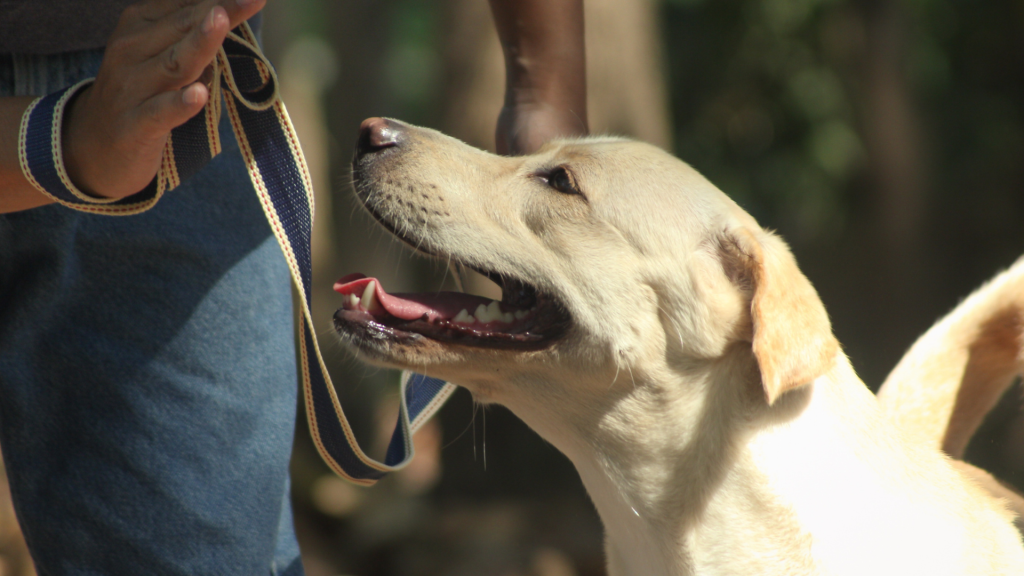
“He never does it with me. As soon as the trainer arrives, he suddenly becomes a model dog!” It’s one of the most common questions we hear in dog training. And the answer isn’t that our dog “respects the trainer more”. Usually they have simply learned very clearly what that particular communication means.
The trainer doesn’t have magic powers
A good dog trainer has learned to notice very small details: the moment the dog looks, the distance from a trigger, the timing of the reward, the way a cue is given and, above all, when to ask for something and when not to.
In dog training, timing plays a huge role. Sometimes a difference of just a few seconds can completely change what the dog understands from what we’re asking.
A dog trainer also has an important advantage: they don’t bring along all the everyday habits we have.
Our dog has learned us, too
A dog doesn’t only learn commands. They also learn their human.
They may have worked out that when we say “come” for the third time, it probably isn’t that important to come the first time. Or that when we say “sit” while holding the bowl, they’ll get it in the end even if they don’t sit.
They don’t do it out of stubbornness. They have simply learned, through our everyday interactions, which things have consequences and which don’t.
A lesson is one thing, everyday life is another
In dog training we may work on a behaviour in a quiet environment, with clear cues and very precise timing.
Then we go home and ask the dog to do exactly the same thing while we’re cooking, talking on the phone, the doorbell is ringing and there’s a whole world of distractions around them.
It makes sense that they struggle.
That’s also why puppy training and dog training shouldn’t be limited to the lesson with the trainer. The behaviour needs to be gradually transferred to different environments and situations.
Basic obedience needs repetition
Basic obedience isn’t simply about the dog learning the words “sit”, “stay” and “come”. They need to learn what these words mean when you use them, in different environments and with different levels of distraction.
If, for example, the dog performs a command perfectly at home, that doesn’t mean they’re ready to do it with another dog walking past.
Dog training is built step by step. From easy to difficult, from few distractions to more.
The goal isn’t for them to listen to the trainer
And here lies perhaps the most important part.
The dog trainer isn’t the person who should be able to handle your dog better than you forever.
Their role is to teach you how to communicate with your dog.
Dog training should give you tools you can use in your everyday life, while puppy training should build a cooperative relationship between you and your dog from early on.
Basic dog training isn’t just commands
Basic dog training is important. We want our dog to respond to their name, to come when called, to walk with us, to wait and to communicate with us.
But basic dog training doesn’t mean much if it stays in a quiet room and doesn’t carry over into real life.
Socialisation, coping with stimuli and the ability to stay functional in different environments are just as important parts of dog training.
You need to become the important person
If your dog listens to the trainer but not to you, it doesn’t mean you need a “firmer hand”. You most likely need more practice, better timing and greater consistency.
Play with them. Reward them when they get something right. Practise basic obedience at different times during the day. Learn to recognise when they’re ready to respond and when the environment is too difficult.
And above all, make training part of your relationship, not a series of commands they have to follow.
Training continues after the trainer leaves
The lesson with the dog trainer is only one part of the process.
Real dog training happens in everyday moments: on walks, at home, during play, when a visitor arrives, when you see another dog and when you ask your dog for something and they choose to work with you.
Basic obedience becomes truly useful when it can be applied in real life.
And puppy training is truly successful when the puppy doesn’t just learn to follow commands, but learns that working with you makes sense.
So, the next time you think “why does my dog listen to the trainer and not to me?”, remember this:
You don’t need to become a better trainer than the dog trainer. You need to learn to communicate better with your own dog.