
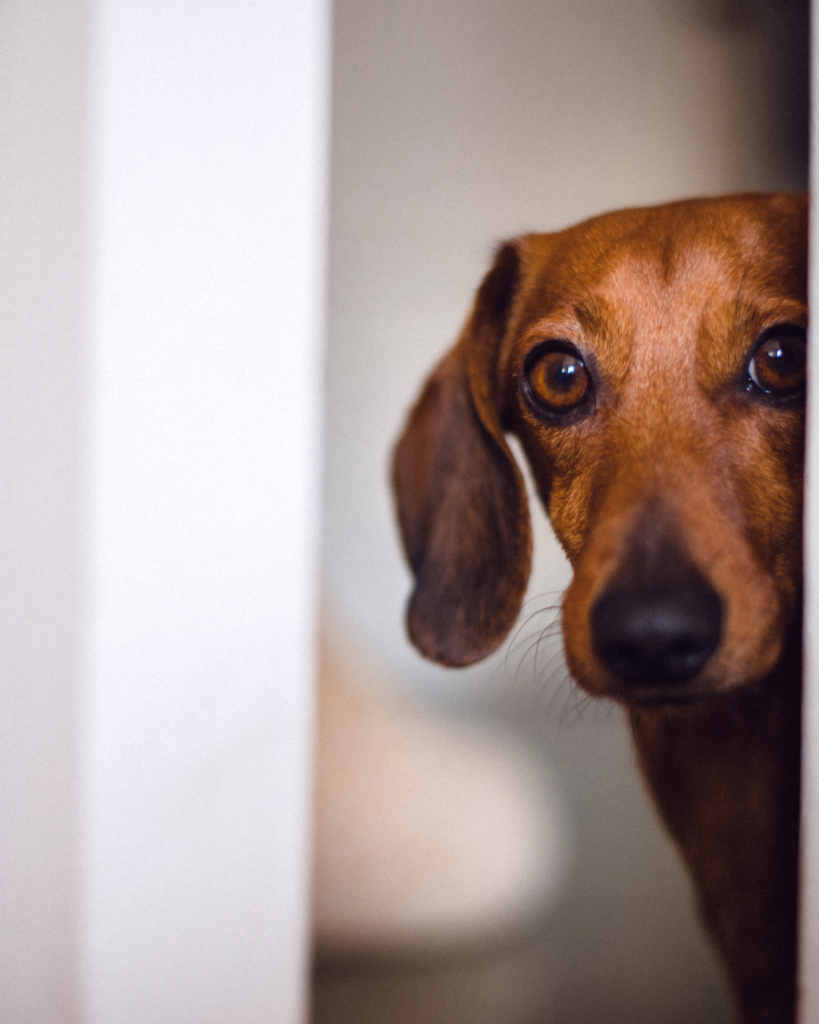
Separation anxiety is a real struggle for many dogs, and it has nothing to do with a “spoilt” or “clingy” dog. When the anxiety appears every time I leave the house, the dog may genuinely be finding it hard to cope with my absence.
What is separation anxiety?
A dog with separation anxiety may start showing anxiety from the moment they realise I’m leaving the house.
They may follow me from room to room, watch my keys, shoes or jacket, and react before the door has even closed.
When I leave the house, the anxiety can increase significantly. The dog may bark, whine, pace restlessly, try to escape or cause damage around the house.
In some cases there may even be pee in the house or poop in the house, even though the dog is normally clean when we’re with them.
Pee and poop in the house don't always mean separation anxiety
Finding pee in the house or poop in the house when we get back doesn’t automatically mean the dog has separation anxiety.
Pee in the house and poop in the house can have many different causes, such as incomplete toilet training, a medical problem, changes in routine or simply the dog being left alone for longer than they could hold on.
However, if pee in the house or poop in the house happens mainly or only when I leave the house and comes with barking, damage around the house or intense anxiety, it’s worth considering separation anxiety.
Barking when I leave the house
Barking is one of the most common signs people notice when a dog is left alone. But here too we need to look at the whole picture.
A dog may bark when I leave the house because they hear noises in the building, because they react to people or other animals outside the window, or because they have learned that barking gets some kind of response.
With separation anxiety, the barking usually comes with other signs of anxiety and is directly linked to the fact that I’m leaving the house.
It isn't revenge
If we come back and find pee in the house, poop in the house, damage around the house, or hear that there was barking while we were out, it’s easy to think the dog is “punishing us” for leaving the house.
That isn’t true.
A dog experiencing intense anxiety isn’t planning revenge. Their behaviour is the result of their emotional state.
Anxiety isn’t a choice, and punishing them after we get back won’t teach them to cope better the next time I leave the house.
“They'll get used to it” can make things worse
If every time I leave the house the dog experiences intense anxiety, it isn’t necessarily a good idea to leave them for longer and longer in the hope that they’ll get used to it.
A dog who spends hours in intense anxiety, with barking, damage around the house or pee in the house and poop in the house, isn’t practising being alone. They’re practising experiencing our absence as something hard.
How do we work on separation anxiety?
Training needs to happen gradually and below the level at which the dog starts to feel intense anxiety.
We can start with very short departures and returns before any barking, panic or other strong reactions appear. Then we gradually increase the time, always according to how well that particular dog can stay calm.
At the same time, we help the dog become more independent inside the house too. They don’t need to follow us from room to room every time we get up. They can learn to relax on their bed, keep themselves busy and spend time without always being right next to us.
When is help needed?
If every time I leave the house the dog shows intense anxiety, constant barking, escape attempts, damage around the house or repeated pee in the house and poop in the house, it’s best not to simply wait for it to pass.
Separation anxiety can be complex and in many cases needs a personalised plan.
Working with a professional trainer who has experience with this issue and, where needed, with a vet or a veterinary behaviourist can make a huge difference.
The goal isn’t simply to be able to leave the house without hearing barking, or to come back and not find pee in the house and poop in the house.
The goal is for our dog to truly be able to be alone without feeling anxiety.